- Religious Tourism
- Villages
Gropello Cairoli
Village on the Via Francigena between Risorgimento history and sacred art


In the heart of eastern Lomellina, along the ancient route of the Via Francigena, lies Gropello Cairoli: a village that quietly preserves centuries of history.
Just a few kilometres from Pavia, this small municipality in the Pavese province is a genuine treasure chest of art, Risorgimento memory and spirituality — an ideal destination for slow tourism, walking pilgrimages and the discovery of the Po Valley's cultural heritage.
History of Gropello Cairoli: from Gallo-Roman Origins to the Risorgimento
The roots of Gropello Cairoli stretch back to Gallo-Roman times, but it was during the Middle Ages that the village gained strategic importance. Located at the fork of a major road network, the town stood at the exact point where travellers had to choose between two routes: northward along the Via Francigena towards Aosta, or westward towards Turin and the Mont Cenis pass. This crossroads made it a vital hub for pilgrims, merchants and travellers for many centuries.
The place name "Grupellum" is documented as far back as the 10th century, when the local lord Bernardo, Count of Parma and Pavia, donated the village to the collegiate church of the Holy Trinity in Pavia. During the Middle Ages, the settlement developed according to the Strassendorf model — a village built along a single main street — one of the few examples still legible anywhere in Europe.
The Cairoli name: In 1888 Gropello adopted its current suffix in honour of the Cairoli family, patriots from this very land. The five sons of Carlo Cairoli — Benedetto, Luigi, Enrico, Ernesto and Giovanni — were leading figures of the Italian Risorgimento. Benedetto went on to serve as Prime Minister of the newly unified Kingdom of Italy. Their bond with this territory runs so deep that it shaped the village's identity forever.
Gropello Cairoli and the Via Francigena: a Must-Stop on the Pilgrimage Route through Lombardy
Gropello Cairoli is an official stage of the Via Francigena in Lombardy, the cultural itinerary recognised by the Council of Europe as a "Major European Cultural Route" since 2004. The Lombardy section covers approximately 126.7 km within the Province of Pavia, passing through some of the most captivating villages of the plain: from Palestro and Mortara, through Tromello and Garlasco, on to Gropello Cairoli, Villanova d'Ardenghi, the Ticino Park, and finally Pavia.
The stretch passing through Gropello Cairoli offers pilgrims and walkers a landscape of rare beauty: flooded rice paddies in spring, poplar groves, irrigation canals, roe deer and storks. The municipal territory is divided into two distinct zones: a lowland area in the ancient bed of the Ticino, rich in springs and natural water sources; and an upland terrace overlooking the river's alluvial valley.
Practical information for pilgrims: The Municipality of Gropello Cairoli, a member of the European Association of Via Francigena Itineraries (AEVF), provides a dedicated tourist brochure, free Wi-Fi hotspots in the town centre, QR code signs with audio guides, and B&B accommodation. Brochures are available at the town hall, the parish church and the municipal library.
The next stage from Gropello Cairoli towards Pavia is entirely flat and approximately 20 km long: after Villanova d'Ardenghi the route enters the Ticino Park, follows the river, and reaches Pavia via the famous Ponte Coperto covered bridge.
What to See in Gropello Cairoli: Top Attractions
Parish Church of San Giorgio
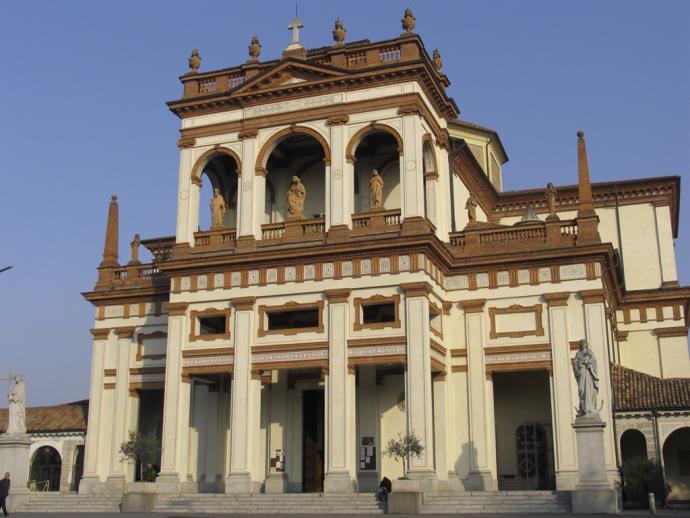
Built in the 17th century and altered several times over the centuries, the Parish Church of San Giorgio is the principal sacred building in Gropello Cairoli. Its terracotta facade, constructed in the early 20th century, features an elegant portico with three front arches. Above the upper loggia stands a fine equestrian statue of Saint George, flanked by Saints Peter and Paul.
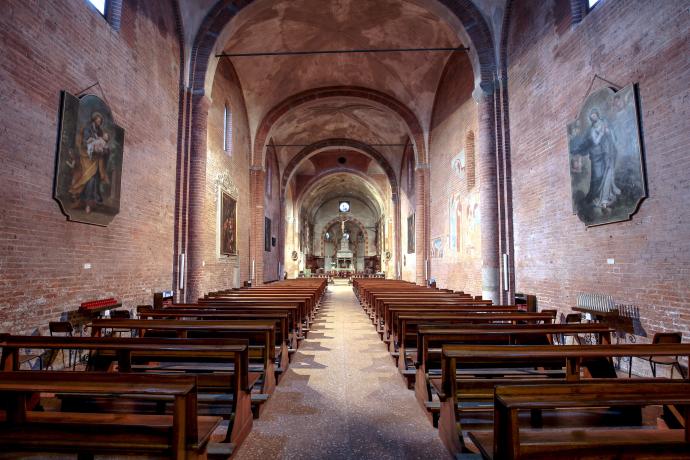
The interior houses a treasure of exceptional value: six polychrome wooden sculptures depicting the Lamentation over the Dead Christ, dating to the 16th century. These works testify to the extraordinary artistic quality found in this corner of Lomellina. The feast of the patron saint George is celebrated every April, bringing the town centre to life for nine days with a fair, a spring market and a show of traditional farming tools.
Church of San Rocco and the Lingiardi Organ
At the south-eastern end of the village, along the main street, stands the Church of San Rocco, built in 1634. Its single-nave interior contains a notable canvas depicting Saint Agatha, Saint Lucy and Saint Apollonia. The true jewel of the church, however, is its organ: built in 1824 by Giovan Battista Lingiardi, founder of the most important dynasty of organ builders in the Pavia area. The instrument has 19 registers and 801 pipes, housed in a magnificent Baroque case of great artistic merit.
Chapel of the Madonna del Buon Consiglio
To the north of the village, near the locality of Cielo Alto, stands the small Chapel of the Madonna del Buon Consiglio, erected in 1714. Probably built on the remains of a 15th-century votive shrine, the chapel was originally connected to the medieval castle complex, as it stood close to the entrance gate of the Parco della Piacevolezza. It was therefore also known as the "Cappella della Piacevolezza" (Chapel of Pleasure) or "Cappella di Corte" (Court Chapel).
The 14th-Century Castle and the Visconti Remains
Of the great 14th-century castle of Gropello Cairoli — built on an earlier fortress, later reorganised by the Visconti and remodelled on several occasions — there remain today two wings joined at a right angle and a corner tower of great evocative power. The tower is distinguished by a large ogival single-light window and terracotta mouldings of clearly Visconti character, a stylistic detail that places the most significant building interventions in the period of Milanese rule. The castle stands directly along the Via Francigena route, and its Parco della Piacevolezza is one of the most evocative spots along the entire pilgrimage path.
Villa Cairoli and the Sepolcreto — National Monument
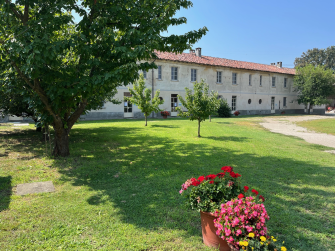
Built against the remains of the castle, the 19th-century Villa Cairoli is one of the most significant civic buildings in the Province of Pavia. Erected on the footprint of the lost wings of the medieval fortress, the villa was the residence of the Cairoli family — five patriot brothers who embodied the Italian Risorgimento ideal at its finest hour.
Adjacent to the villa, the Sepolcreto (family burial chapel) was declared a National Monument in 1890. Originally the castle's own church, dedicated to Saints Carlo and Gerolamo, it holds the mortal remains of the Cairoli brothers: a place of remembrance and reflection that draws visitors from across Italy each year, a living testament to the sacrifice and dedication of these heroes of the Risorgimento.
Slow Tourism and Nature: Gropello Cairoli and the San Massimo Nature Reserve
San Massimo Nature Reserve: a Unique Ecosystem in Europe
In the south-western sector of the Lombardy Ticino Park, between the town of Gropello Cairoli and the hamlet of San Biagio di Garlasco, lies the San Massimo Nature Reserve: one of the most precious and rare natural areas in the Po Valley, and among the most extraordinary in all of Europe.
The Reserve extends over approximately 600 hectares — of which 400 are covered by uninterrupted natural forest — and has been classified as a Site of Community Importance (SCI IT2080015 "San Massimo") since 2004, with part of the area further designated as a Special Protection Zone (SPZ). Its exceptional natural value derives from the presence of the last significant expanses of Black Alder (alder carr) wetland forest in the Po Valley: black alders, oaks, poplars and willows grow on ground crossed by ditches and marshes, forming a riparian forest that is unique at an international scale.
Natural areas alternate with farmland, rows of native fruit trees, traditional irrigated meadows and poplar plantations. The Reserve is also a working farm managed using traditional methods: Carnaroli and Vialone rice and maize are grown here using exclusively organic fertilisers and low-temperature drying techniques — a model that demonstrates how biodiversity conservation and sustainable agriculture can coexist harmoniously.
Flora and Fauna: Extraordinary Biodiversity
The alder carr hosts a heronry of approximately 1,000 birds, including little egrets and night herons. Grey herons, great white egrets and purple herons can be easily spotted in the rice paddies and small wetland areas. Along the forest paths, visitors may encounter green woodpeckers, great and lesser spotted woodpeckers, golden orioles, wrynecks, tawny owls, barn owls, little owls, nightjars, common buzzards, Eurasian hobbies, sparrowhawks and honey buzzards. Roe deer, reintroduced in 1999, move freely through the woodland alongside badgers, hedgehogs, foxes, hares and fallow deer.
The flora includes rare species such as the royal fern (Osmunda regalis) and Marsilea, both of Community interest. The Bosco Francesco Barbieri — a 16-hectare Black Alder woodland at the foot of the Ticino terrace within the municipal territory — is a further habitat acquired by the Ticino Park in memory of the zoologist Francesco Barbieri.
Visiting the Reserve: Access is permitted exclusively by prior reservation, with mandatory accompaniment by authorised staff. The reserve is closed to the public from 17 September to 31 January. Info: info@riservasanmassimo.net · Tel. +39 0382 823710 · www.riservasanmassimo.it
Gropello Cairoli is also accessible by train from Vercelli station, making it an ideal starting point for walking or cycling excursions along the Via Francigena and the Ticino Park trails.
Practical Information for Visiting Gropello Cairoli
How to get there: By car from Pavia along the SS596 towards Mortara. By train with a stop at Gropello Cairoli on the Vercelli–Pavia line.
Where to stay: The village offers B&B accommodation for Via Francigena pilgrims. Information available at the town hall and the parish church.
When to visit: In spring for the feast of patron saint George (April, 9 days) and to see the flooded rice paddies. In autumn for the Festa dei Ragazzi (September), a tradition of over seventy years in which the town's districts compete in games and activities.
Via Francigena accessibility: Free Wi-Fi, tourist brochure, QR code audio guides and an AEVF information panel are all available.