- Villages
San Ponzo Semola
A medieval village frozen in time among the hills of the Oltrepò Pavese

On the left bank of the Staffora stream, among the meadows and ridges that frame the road to Varzi, lies San Ponzo Semola, one of the most evocative hamlets of the municipality of Ponte Nizza.
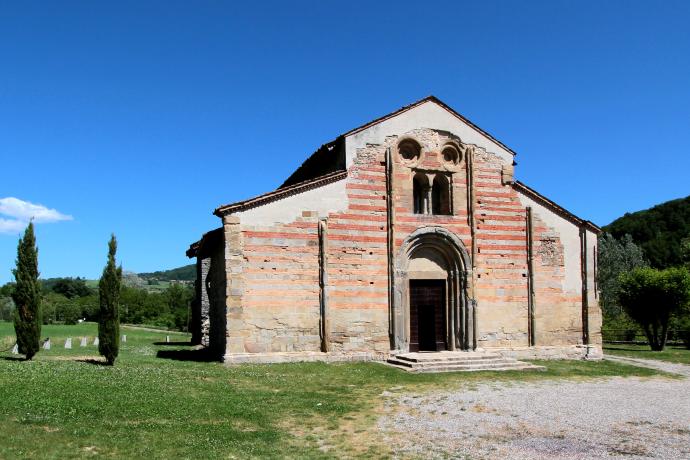
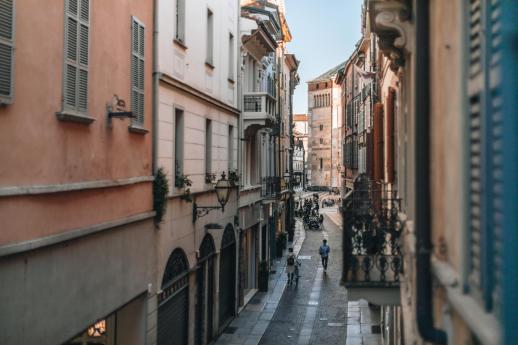
Stone lanes, quiet little squares and a Romanesque parish church listed as a national monument: San Ponzo Semola is one of those places in the Oltrepo Pavese where time truly seems to have stood still.
San Ponzo Semola on the Voghera-Varzi Greenway: explore it by bike or on foot
San Ponzo Semola lies along the Voghera-Varzi Greenway, a 33-kilometre cycling and walking path that follows the entire Valle Staffora retracing the route of the electric railway opened in 1931 and closed in 1966. The village is one of the natural stopping points on the Apennine stretch of the Greenway, running gently from Salice Terme all the way to Varzi with an average gradient of just 1.24%, making it suitable for cyclists of all abilities, families with children and keen walkers alike.
Riding along the cycle path you pass through a landscape of vine-covered hills and chestnut woods, with the Staffora stream as a constant companion throughout. San Ponzo Semola is reached via a short detour from the main route and is one of the most captivating rest stops along the entire itinerary: the little square with its Romanesque church, the silence of the ancient village and the opportunity to head up into the surrounding woods towards the hermit caves make this far more than a simple pause. The Greenway is fully surfaced with horizontal and vertical signage throughout, drinking fountains, picnic areas and e-bike charging points at intervals along the route.
History of San Ponzo Semola: from Lombard kings to the Sforza
The origins of San Ponzo Semola reach back into the early Middle Ages. In 943, kings Ugo and Lotario donated the village to the Bishop of Pavia, together with the nearby settlement of Cecima, marking the beginning of a long period under the authority of the Pavian episcopate. For centuries the small settlement formed a true exclave of the Diocese of Pavia surrounded by the lands of the powerful Malaspina family, from whose jurisdiction it always remained independent.
In the sixteenth century the fief was subinfeudated to the Sforza of Santa Fiora, who were also lords of Varzi, the family later known as the Cesarini Sforza. San Ponzo remained an independent municipality until 1928, when it was merged into the present-day chief town of Ponte Nizza. It took its final name of San Ponzo Semola in 1863, where "Semola" refers to the small stream descending from the mountains and running alongside the village.
The Parish Church of San Ponzo: Lombard Romanesque architecture and national monument
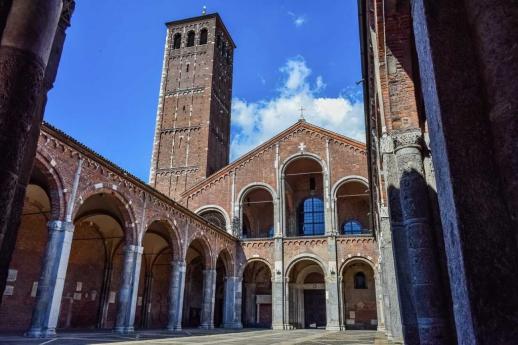
At the centre of the main square stands the Parish Church of San Ponzo, the historic and architectural heart of the village. The building, erected in the eleventh century in Lombard Romanesque style, has been declared a national monument: a white marble plaque on the bell tower facade reads "National monument of Lombard architecture, 11th century".
The village did not grow up around a castle, nor does it have a defensive wall: its urban layout developed instead around the ancient parish church, testimony to the religious and civic centrality of this place for all the surrounding territory. From the original medieval structure there survive to this day the lower section of the square-based bell tower, with its characteristic narrow lancet windows topped by semicircular arches, and stretches of the original masonry.
In the fifteenth century the church underwent extensive remodelling, but the alterations did not erase the Romanesque framework. The entrance portal is preceded by a Renaissance narthex of square plan with a cross vault, supported by four columns set on tall sandstone plinths. The four sides of the narthex are defined by round arches; the roof has three triangular pitches covered with traditional curved tiles. The external cobbled paving with terracotta decoration adds a further layer of charm to the building as a whole.
Inside the church: frescoes, the baptismal font and the relics of the saint
The interior of the parish church preserves elements of extraordinary historical and devotional value. In the first bay on the right stands the stone baptismal font dated 1161, one of the most precious medieval artefacts in the entire Province of Pavia. This ancient font bears witness to the importance of San Ponzo as a baptismal church for the whole surrounding area: originally the baptistery was an external chapel accessible through a separate door whose outline is still visible on the outer wall.
The walls of the building preserve traces of frescoes datable to the sixteenth and eighteenth centuries, a visual layering that tells of centuries of devotion and care by the local community. To the right of the presbytery is a rectangular space with the altar dedicated to San Ponzo: here is kept the silver and crystal urn containing the relics of the saint — the skeleton without the skull, which according to tradition is held instead in the church of San Giorgio in Fortunago, where legend has it that the oxen transporting it stopped and refused to go any further.
San Ponzo: the hermit martyr of the Theban Legion
The figure of the saint who gives the village its name is steeped in history and legend. Ponzo was a Roman soldier of the Theban Legion, a military unit whose members had been recruited along the course of the Nile. Born in Rome in the third century AD to a noble pagan family, he was baptised by Pope Pontianus and devoted himself to Christian preaching. Having arrived in the Valle Staffora as a legionary, he deserted the army and retreated into hermitage in the area then known as Le Cascine, which subsequently took his name.
San Ponzo is celebrated on 14 May, the date on which the small village comes alive with pilgrims and the faithful arriving from all over the province and beyond. The feast day is one of the most deeply felt devotional occasions in the Oltrepo Pavese, a tradition passed down unbroken for centuries.
The Caves of San Ponzo: nature, spirituality and miraculous water
About three kilometres from the village, in the direction of Monte Vallassa, lie the Caves of San Ponzo, natural cavities carved over millions of years by the action of water on the sandstone rock. According to tradition, these caves were the refuge where the hermit spent years in prayer and penance before his martyrdom.
The caves are reached by following a private road through chestnut woods. Nearby there is a spring whose drops of water seeping from the rock are considered miraculous by pilgrims, who still collect them today as an act of devotion. The site is also one of the most important fossil deposits in the Oltrepo Pavese, which adds a further scientific and naturalistic interest to a visit here.
How to visit San Ponzo Semola: practical information
San Ponzo Semola lies in the Valle Staffora in the Province of Pavia and is easily reached both by bicycle along the Voghera-Varzi Greenway and by car along the provincial road connecting Voghera to Varzi. The village belongs to the municipality of Ponte Nizza, where the Greenway has a convenient, well-signposted access point. Visitors arriving by train can reach Voghera and set off from there by bike along the cycling route. Access to the village itself is straightforward; sturdy shoes are recommended for exploring the cobbled lanes and for the walk up to the hermit caves.
The visit pairs naturally with other places of great spiritual and architectural interest in the area: the Hermitage of Sant'Alberto di Butrio, also in the municipality of Ponte Nizza, is another of the most significant destinations in the Oltrepo Pavese for anyone who loves medieval villages, history and the unspoilt nature of Lombardy.