- Art & Culture
- Villages
- Food & Wine
Clusone
Clusone is called the “painted city” for its numerous fresco and is rich in history and art.


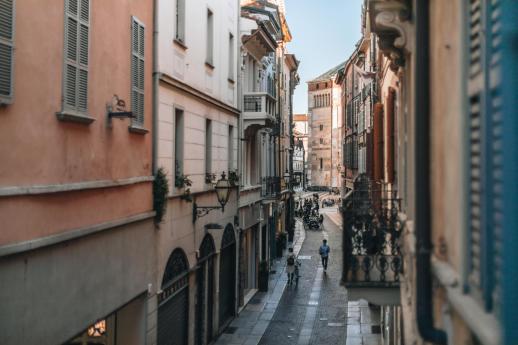
Nestled on a beautiful plateau in the Seriana Valley, where it is the most important town, the well-preserved historic centre of Clusone is laid out irregularly over different levels and is characterised by a unique, labyrinthine network of narrow alleys and side streets.
The panoramic view from the top of the town is dominated by the majestic Basilica dell’Assunta, preceded by a spectacular zigzag staircase and flanked by a portico; the harmonious interior houses numerous works by sculptor Andrea Fantoni.
Opposite the Basilica stands the Oratorio dei Disciplini, renowned for its exquisite exterior frescoes (The Triumph of Death and The Danse Macabre). The heart of the town is Piazza dell’Orologio, overlooked by the 15th-century Town Hall, which incorporates a massive medieval tower featuring an ingenious planetary clock, which is regarded as the town’s symbol.
Visitors to the town will certainly enjoy their time there, savouring the traditional Biscotto di Clusone, an almond and chocolate biscuit which was first created in 1920 and has been produced ever since.
Clusone Pine Forest
Beyond the historic centre, the Clusone Pine Forest evokes another era in the town’s history: in the early 20th century, it was a holiday resort, and Art Nouveau villas can still be found amongst the greenery. The woodland there is mixed: Scots pines grow alongside spruce and deciduous trees, which change colour in autumn. Today, the pine forest is criss-crossed by over 22 km of footpaths and is also home to an adventure park, with trails suspended among the trees.
The easiest way to explore it is to take a walk to Prati Mini, an easy circular route of about an hour and a half with an elevation gain of 100 metres, starting at the Prati Mini Athletics Centre. You walk along tarmac and dirt tracks as far as the entrance to the adventure park, then take the ‘San Rocco’ path, which is marked by a wooden arrow.
As you continue upwards, you will come to the Cappelletta dei Morti Vecchi, a small chapel built in 1776, in memory of the plague of 1630, along what was once a route to the Val Seriana. A little further on, in a clearing overlooking the plateau and the surrounding mountains, stands the small 16th-century church of San Rocco, dedicated to the patron saint of plague victims. Granite boulders, known as erratics, also appear along the route; these were carried here in ancient times by the Camuno Glacier.