- Art & Culture
Luca Campigotto. An Inventory of Mantua


Luca Campigotto. Mantua Inventory
edited by Mario Peliti
On display and in an extraordinary volume, the new chapter in the long-running documentation project on Mantua and its province, promoted by the Fondazione Banca Agricola Mantovana
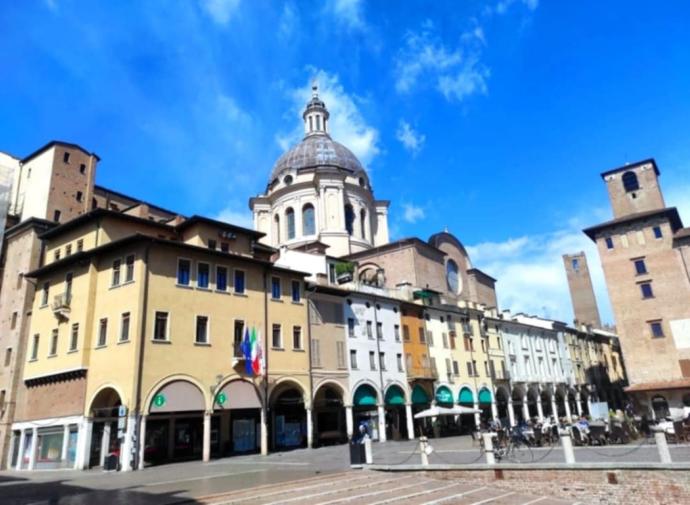
To take inventory of a city as rich in history, art, labor, and nature as Mantua is, in a way, to “invent” it. And it is precisely by delving into the Latin etymology of the title chosen for this new, splendid chapter—the fifth—of the long-term project commissioned by the Fondazione Banca Agricola Mantovana from leading Italian photographers, chaired by Alberto Arrigo Gianolio and directed by Luca Giovannini, that Luca Campigotto has explored and reinterpreted the city of Mantua and its province on two parallel tracks: as if it were an inventory—a list of experiences and memories of immense value—but also as an invention. At its root is the verb “to find,” invenire in Latin. And by choosing, among the first images in the volume, the fresco of the Battle of Louverzep, painted by Pisanello in the Ducal Palace between 1436 and 1442 and “rediscovered” in 1969, Campigotto reminds us that every photograph is always a small discovery, an invention, and at the same time a battle against time.&
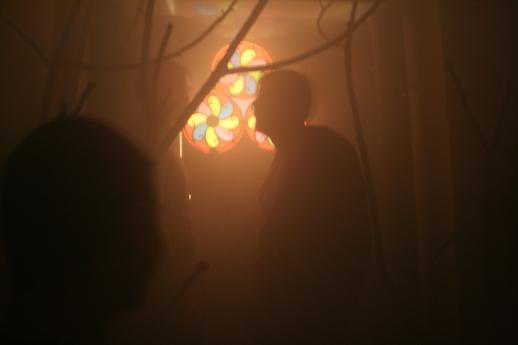
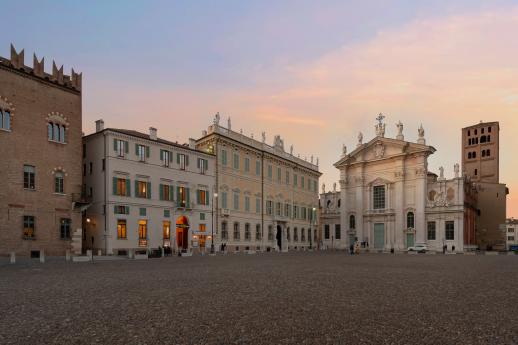
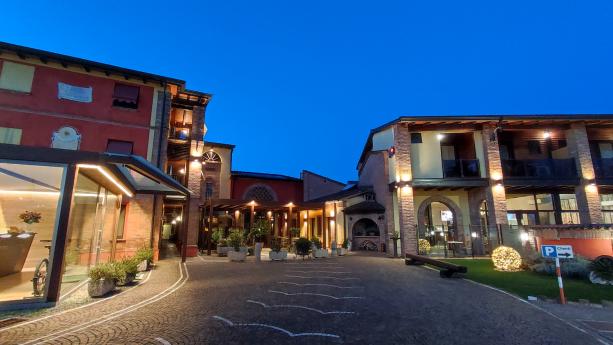
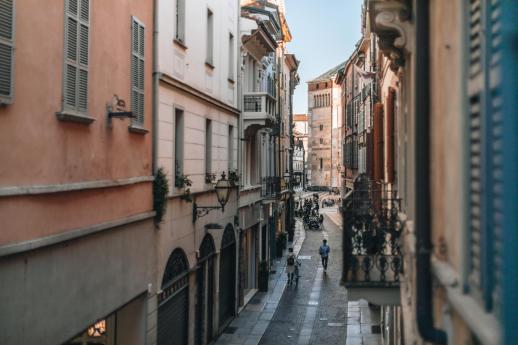
Perhaps it is no coincidence, then, that this highly sensitive Venetian photographer—who found so much of his city of water in Mantua—chose to include the time of each shot in the captions. And most of them are taken at night. Night is a time dear to Luca Campigotto, for its magic, for its solitude, for that marvelous theatrical possibility of evoking human presence where it is absent. In the urban landscape of a Mantua almost entirely alien to sunlight, and through a disorienting chromatic invention, the places of history and great architecture—civil and religious, from the Renaissance to Rationalism—speak, as do the spaces of daily life, among streets, cars, bicycles, and illuminated windows that “open up” the darkness of the volumes and unite interior and exterior, public and private.
In Luca Campigotto’s Mantua journey, all this takes place before midnight. At 12:11 a.m. on September 22, 2025, exactly halfway through the volume and the exhibition itinerary, the journey of this photographer-author—who has made the ancient and contemporary landscape the subject of his long-standing research—changes, takes another direction, and moves beyond the historic center toward sites of industrial production, navigating active and abandoned sites in a highly evocative economic counterpoint. Alongside this, uniting such diverse realities is a network of transport routes that winds through the centuries across land and water, through canals, lakes, bridges and pontoon bridges, rafts, roads, and railway junctions.
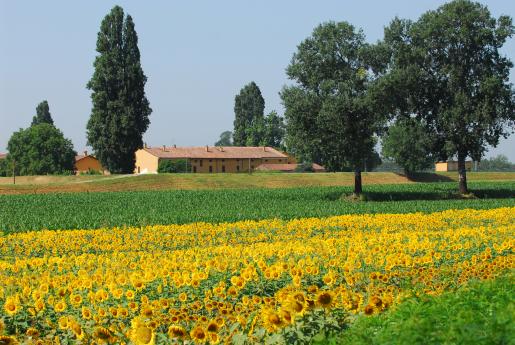
One more step, and the countryside—with its seasons and its fruits—enters the inventory of a province as rich and industrious as Mantua, from Bozzolo to Torre D’Oglio, from Piubega to Roncoferraro, where the riverbanks widen, the wheat sways in the wind, the fields are plowed in anticipation of the next harvest, and the trees grow freely, mighty, or in orderly rows. The hand of man is everywhere; it is Labor omnia vincit. Luca Campigotto offers his own particular take on Virgil’s maxim, namely that even today, invention—that effort to catalog, discover, write, and rewrite our world through images—can still achieve so much.&
BAM Foundation
Since its inception in 2000, the Fondazione Banca Agricola Mantovana (BAM) has promoted the social, economic, and cultural well-being of Mantua and its citizens. As part of this inspiring initiative, the BAM Foundation launched, starting in 2004, a major photographic documentation campaign that highlights the heritage of the city and its surrounding area. Over the years, the BAM Foundation has commissioned a series of projects of extraordinary artistic and documentary value from Italy’s most renowned photographers. Under the guidance of Mario Peliti, curator and editor, the project has featured the participation of Gianni Berengo Gardin, Gabriele Basilico, Antonio Biasiucci, Olivo Barbieri, and now Luca Campigotto. Over time, these campaigns have given rise to a photographic collection that is unique in Italy for its quality, dedication, and rigor.&
Luca Campigotto
Born in Venice in 1962, Luca Campigotto earned a degree in Modern History, dedicating his thesis to travel literature during the era of the great geographical discoveries. And Luca Campigotto has made travel and the act of discovering through travel his life’s story and his profession, moving and photographing with equal sensitivity from Venice to Cairo, from China to New York. He has published some twenty monographs, including Atlante sentimentale (Inches Music Group, 2024), American Elegy (Silvana Editoriale, 2021), Disoriente (Postcart, 2018), Iconic China (Damiani, 2017), Teatri di guerra (Silvana Editoriale, 2014), Gotham City (Damiani, 2012), My Wild Places (Hatje Cantz, 2010), The Stones of Cairo (Peliti Associati, 2007), Venice, Nocturnal Imagination (Contrasto, 2006), Molino Stucky (Marsilio, 1998), Venetia Obscura (Peliti Associati, 1995). His works are held in international museums and institutions, including MEP, Paris; CCA, Montreal; The Warehouse, Miami; The Hearst Collection, New York; Fidelity Collection, London; MAXXI, Rome; Fondazione MAST, Bologna; UniCredit Group, Milan; Fondazione Sandretto Re Rebaudengo, Turin; Metropolitana, Naples, and Palazzo Fortuny, Venice.
OPENING HOURS
Mon: 9:00 AM / 7:00 PM
Tue: 1:00 PM / 7:00 PM
Wed - Sun: 9:00 AM / 7:00 PM
FREE ADMISSION