• Art & Culture
    • Villages
    • Religious Tourism

Lomello and its Christian buildings

Village of strategical importance since ancient times, here you can discover the great Romanesque Lombard architecture

Lomello was founded in ancient times by the Levis, probably a Ligurian tribe: the name derives from Laevum mehl, “fortified place of the Levis”, and in the Roman age it became Laumellum.

The Romans, great road builders, created routes which crossed Lomellina in direction Transalpine Gaul: Lomello became a mansio, a place of rest, refreshment and change of horses for travelers. The city was then fortified in late Roman age, to face the invasion of the Visigoths.

Centuries later, in the Lombard period, Lomello maintained a strategic importance as castrum, and tradition has it that queen Theodelinda and Agilulf got married here.
The construction of the Baptistery of San Giovanni ad Fontes probably dates to the 7th century. The small building is built of bricks and has a Greek cross plan, the arms alternating with semi-cylindrical barrel-vaulted niches. Inside, the room is octagonal, a symbol of Resurrection: the sides symbolize the seven days of creation and the eighth day of the Last Judgment. The light gets in from eight windows, which on the outside are combined with cuspidated niches, and from the lantern that culminates at the top of the dome.

The hexagonal baptismal font is unusual in the Lombard area, but typical of regions such as Istria or the area of Aquileia, where it was introduced by workers of Middle Eastern origin.

At the beginning of the 11th century, counts from Pavia Palace settled in the castle of Lomello following the rebellion of Pavia. It was then that the basilica of Santa Maria Maggiore was built - or perhaps rebuilt.

Of imposing proportions, it is an early example of Lombard Romanesque, work of workers updated on the language of the great French abbey of Cluny. The three naves are divided by powerful pillars and end in three apses. Large arches mark the rhythm of the central nave, visually lightened by paired windows, in perspective flight towards the altar. Outside we appreciate the decoration of Lombard bands and niches on the transept and apse. As the name suggests, they will become typical of Lombard sacred architecture of this period.

The façade of the church and the ancient bell tower was probably built against the city walls, but this portion of the church was destroyed by a collapse in an uncertain age.
In the parish rectory you can visit the Museum of stuccoes, where the fragments of the precious decoration that once decorated the central nave of the church are preserved.

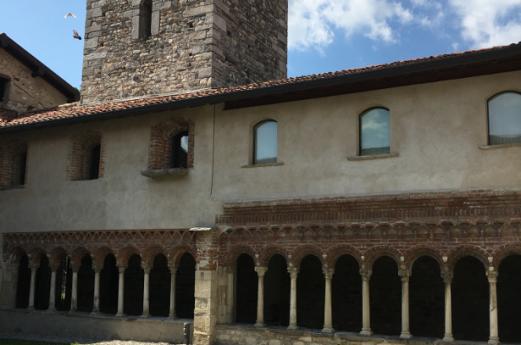
If you still have time, do not miss the church of San Michele: built outside the walls of the ancient town a few decades after Santa Maria Maggiore, the dedication to the Archangel suggests a reconstruction of an ancient building, as Lombards were particularly devoted to Michael.

According to the tradition, relics of the True Cross are preserved in the church: they had been donated by the Reverend Guglielmo de Grossis, who stopped in Lomello during a journey to the papal court of Avignon and there he passed away on May 4, 1370.


Text by FIAMMA BOZZOLOConfGuide-GITEC 

CLICK HERE to discover her other itinerary proposals.
Take me here: Lomello and its Christian buildings

On the same topic

The show is online in Lombardy

The show continues at home, in Lombardy. Discover the plays, films, concerts, videos and podcasts available for free online
  • Art & Culture
The show is online in Lombardy

Bergamo, Crespi d'Adda

  • Art & Culture
Villaggio Crespi d'Adda

The Ghost of Manigunda

In Varese the legend of the ghost of Manigunda to the monastery
  • Art & Culture
Legends of Varese: the Ghost of Manigunda at the Cairate Monastery

Lago di Iseo: history, nature and…

From the recently rediscovered Roman spa in Predore to the Liberty architecture of Sarnico, via the enchanting town of Lovere and surprising natural phenomena
  • Art & Culture
Lago di Iseo cultura, natura e...

Strolling through Milan's southeastern agricultural park

  • Art & Culture
Milan South Agricultural Park

Monuments Pavia

Ancient squares, historic houses, statues, religious buildings, museums ... in Pavia and its province
  • Art & Culture
Monument Pavia, what to see

What does a Brazilian do at La Scala?

The affairs of Brazil's greatest composer and his connection with La Scala Theater in Milan
  • Art & Culture
What does a Brazilian do at La Scala in Milan?

Museums Brescia

Brescia: the ideal destination for those who love art. Countless opportunities to visit exhibitions and to attend cultural events
  • Art & Culture
Museums Brescia, hints on visiting

Milan, a novel city

Discovering the writers of the past, between the places and the atmospheres of Milan that have inspired great masterpieces of literature
  • Art & Culture
Milan, a novel city

What to see in North Milan

The North Milan Area, between North Park and some must-see gems
  • Art & Culture
North Milan Area

Milan in the 1920s: Déco and tradition

  • Art & Culture
Milan in the 1920s: Déco and tradition

Theaters Mantua

Sumptuous rooms and golden stages are the setting for the theatrical seasons of Mantua
  • Art & Culture
Theaters Mantua, experiences in Lombardy

Varese UNESCO

4 siti UNESCO, indissolubilmente legati al paesaggio: Monte San Giorgio, Isolino Virginia, Monastero di Torba, Sacro Monte di Varese.
  • Art & Culture
Quinta cappella al Sacro Monte di Varese

Monuments Cremona

Cremona: a splendid city of art with a sober elegance and many monuments, to be visited on foot or by bicycle
  • Art & Culture
Monuments Cremona, visiting Lombardy

Three Days in Milan: A Cultural Journey Through Time, Art, and Innovation

Plan the perfect 3-day trip to Milan with the YesMilano City Pass. Visit top attractions like the Duomo, Sforza Castle, and Leonardo da Vinci Museum. Skip lines and enjoy free audioguides!
  • Art & Culture
discovering milano

Diocesan Museum

Pre-view of the exhibited art-works
  • Art & Culture
Diocesan Museum

Festival of Ethical Photography

Responsible photojournalism: The Festival of Ethical Photography
  • Art & Culture
Festival della Fotografia Etica

Museums Lodi

The museum reality of Lodi is heterogeneous. It preserves naturalistic and scientific collections, archaeological and art collections
  • Art & Culture
Museums Lodi, exploring Lombardy

Milan, following Leonardo’s footsteps

Pictorial suggestions and drawings. Machines and impressive hydraulic engineering works. In Milan, a journey in the wake of Leonardo
  • Art & Culture
Milan, following Leonardo’s footsteps

San Pietro a Gemonio

This church is one of the points that remain more etched in the memory of the travelers who travel the Varese-Laveno
  • Art & Culture
San Pietro a Gemonio and the Salvini Museum in Cocquio Trevisago