I found 523 results for Borghi

Village of Morbegno

Morbegno - ph: Giancarlo Botta

Sports for all tastes in Valle Camonica

There is a summer Camonica Valley and a winter Camonica Valley. A white valley dedicated to winter sports, but also green with meadows and forests
Camonica Valley - Tonale

Autumn trip to villas and castles

An autumn adventure of history & beauty: explore the autumn charm of Lombardy's villas and castles.

Travacò Siccomario

The municipality of Travacò Siccomario is located two kilometers south of Pavia, between the Ticino and the Po rivers, at their confluence. Together with the municipality of San Martino Siccomario, it is part of the territory called Siccomario. The Siccomario: Name and Territory in the Oldest Documents To address the issue of the origin of the rather unusual name of Travacò Siccomario, it is necessary to examine the two terms "Travacò" and "Siccomario" separately, based on the objective data derived from available archival documentation. From this, it is clear, as will be shown, that the imaginative interpretations suggesting that "Siccomario" comes from "sicut mare" or "siccum maris," as proposed by some chroniclers, are completely fanciful and unfounded. The same applies to those claiming the name derives from a category of swamp reclamation workers called "sighemarii." However, before delving into this, it is essential to clearly define the territorial extent of Siccomario. Geographical Delimitation of Siccomario The toponym "Siccomario," or more precisely the coronym (since it refers to a territory rather than individual towns or settlements), identifies a well-defined area. In 1330, the chronicler Opicino de Canistris describes the territory south of Pavia as follows: "The central part of the territory south of the city is bordered by three rivers. The Po at 5 miles, the Gravellone at 500 meters, and the Ticino along the city's walls themselves. The smallest part of the territory in this direction lies between the Ticino and the Gravellone, all belonging to the Municipality [of Pavia], and contains only meadows and the site of justice." This is the current Borgo Ticino. "The second part is full of excellent fields and produces abundant fruits of various kinds." This part, between the Gravellone and the Po, is called Siccomario ("Siccomarium appellatur"). Here, wines are produced that are not harmful in summer due to their low alcohol content, which, while not of high quality, still have their merits. Near the city, within Siccomario, there is a place commonly known as Terra Arsa, located one and a half miles from the city walls, where St. Martin of Tours was raised. There is another part beyond the Po, which is the true Oltrepò. Further details show that Opicino adds: "This city is surrounded, especially in Siccomario, by many gardens and orchards, and many pomarii," referring to orchards where apples are cultivated. From this description, it seems that Siccomario was the land between the Gravellone and the Po, with a part of it, where St. Martin's settlement was located during Opicino's time, being called "Terra Arsa." This fact is corroborated by medieval documents, where references to San Martino always say "San Martino in Terra Arsa," never "in Siccomario." Thus, the expansion of the term Siccomario to San Martino is certainly a more recent development. The Term "Siccomario" in the Oldest Documents The oldest document referring to the current Siccomario area is a donation made by Charlemagne to the great Monastery of St. Martin of Tours in 774, after he besieged Pavia and defeated the Lombards. In this document, although it deals with churches and lands located in Siccomario, the term "Siccomario" does not appear. At this time, and for several centuries afterward, the name "Siccomario" continues to be absent. However, the adjective "arida" is used, but not "terra arsa," which first appears in 909, in a document by Berengar I, which mentions "pratellos quinque" [five meadows] in a place called terra arsa, a meadow with a small grove. So, during this period, the name "terra arsa" is used, but the toponym Siccomario does not yet exist. After almost two centuries with no relevant documentation, in a document from October 2, 1099, we finally see the first mention of "Siccomario." The Abbey of St. Maiolo in Pavia, in fact, sells goods "in loco et fundo Sigemario at Pozzallo" ("Locus et fundus" is a term used to describe a small rural settlement, typically a village with its surrounding land). In any case, the most logical explanation is that "Sigemarius" is a Germanic personal name, well attested in Lombardy as early as the 8th and 9th centuries, probably of Frankish origin, although this cannot be stated with absolute certainty. Who this Sigemario was, why he had property in this area, and why his name was left behind is unclear. However, an interesting coincidence reinforces this interpretation: there was a Monastery in Pavia in the 9th century called "de Sigemario." This fact is enough to attest to the existence and circulation of this name. The Monastery "de Sigemario" was named as such because it was founded by someone named Sigemario. However, the exact location of this Monastery is not known, and by the 10th century, it disappears from the records. Thus, the most logical explanation is that "Siccomario" derives from a personal name that eventually became a toponym. The traditional explanation was that it came from "secco mare" (dry sea) until Olivieri, around 1930, proposed the interpretation linked to the name "Sigemarius." Olivieri was a prominent toponymist who wrote a dictionary of Lombard toponymy, and all subsequent scholars have adopted his interpretation. Thus, the name Siccomario, in the form "Sigemario," very similar to a personal name, first appeared in the 11th century, in 1099, and became firmly established from that time on. Other Important Documentary Evidence From this time onward, particularly starting in 1120, we have numerous documents related to the goods that the Abbey of St. Maiolo owned in this area, especially lands, which were granted, sold, and expanded through new purchases. Therefore, the history of this area is increasingly well documented. Let's look at them quickly. The first document after 1099 is dated 1120 and mentions a "clausura super fluvium Ticinum" (the "clausura" was a fenced-in area, usually a vineyard). "Super fluvium Ticinum" means "beyond the Ticino river." The document goes on to say "in loco et fundo Casellae qui dicitur in Sigemario prope Pozzolum." There is a whole series of documents that mention the Ticino and "loco et fundo Sighemario" with various specific places located within the Siccomario territory. Furthermore, in 1130, there is mention of lands "in Sigemario" being donated to the Church of St. Mary of Bethlehem. At one point, in 1171, a vineyard plot appears in "Sigemario vetulo," meaning the old Siccomario. This indicates the need to distinguish the old Siccomario from a new territory, which likely had not been previously named this way but was now recognized as part of the Siccomario. For the entire 12th century, we see a series of place names until 1180, when a new and interesting element of the landscape appears: "in loco et fundo Sigemario prope Ruptam." This is the first mention of the name "Rupta," which had never been attested before. In this regard, the testimony of the Anonymous of the 800s is interesting, as he states that the Rotta divides the Siccomario in half, with "terra arsa" (the territory of San Martino) on the left and the true Siccomario on the right. The Rotta thus separated Siccomario from "terra arsa." There is also a papal bull from 1187 for the Monastery of St. Agatha of Pavia, listing many properties scattered throughout Northern Italy. At one point, it mentions "prata omnia super Ticinum," meaning "all the meadows beyond the Ticino," but without specifying the location. Soon after, the same bull mentions "ad Sanctum Martinum in terra arsa campum unum," but still does not mention Siccomario. This document, although from 1187, likely copies an older document, possibly from before the 11th century, because it would have been impossible at this time to not mention Siccomario when discussing lands between the Ticino and the Po rivers. Still, in the same document, we find "Sigemario vetulo" (old Siccomario) and later "S. Maria di Siccomario," which, in 1187, is under the jurisdiction of the Monastery of St. Maiolo. Regarding the Term "Travacò" Regarding the term "Travacò," we can refer to Olivieri's "Dictionary of Lombard Toponymy" and the numerous commentators and scholars who reference it, indicating "travacca" as a structure used to reinforce a riverbank, which is particularly suitable given the nature of the area. The "travacca" would thus be an element used to reinforce a riverbank. In Lombardy, this is a common name, and there are farms named "Travacca," "Travaccò," etc. The accent on the final "o" is typical of other names that originally ended in "atum." Therefore, the name likely originated as "trabaccatum," meaning a place where a "trabacca" (reinforcement element) was built along a watercourse. Fonte: Comune di Travacò Siccomario


San Damiano al Colle

This small village, made up of numerous hamlets scattered across the hills, is one of the ideal places to lose yourself among the beautiful roads lined with vineyards. Bordering the province of Piacenza, it stands on a hill dominated by the late medieval castle (14th–15th century), built on a previous fortification dating shortly after the year 1000. Known as “Sanctus Damianus,” it appears in the 1452 Statuta stratarum as part of the Ultra Padum district. Until 1677 it belonged to the feudal lordship of the Bishop of Tortona, as part of the fief of Portalbera; later, after being divided, it was sold for the sum of 60 lire per “hearth” to Count Galeazzo Mandelli of Pavia. In the territorial division of September 15, 1775, San Damiano was included in the Voghera district. In the senatorial decree of August 29, 1789, which divided the province of Voghera into three cantons, San Damiano was placed in the third canton of Broni. The prefect of the Department of Marengo, pursuant to the law of the 28th piovoso year VIII (February 1800), appointed the maires and deputies of the municipality of San Damiano and Mondonico by decree of the 23rd fructidor year IX (September 1801). San Damiano was then included in the Department of Marengo and the district of Voghera. According to the royal edict of October 7, 1814, which reorganized the provinces under the Senate of Piedmont and their division into judicial districts, San Damiano was provisionally assigned to the mandamento of Montù Beccaria, belonging to the province of Voghera. In 1859 San Damiano became part of the province of Pavia, within the ninth mandamento of Montù Beccaria in the district of Voghera. Until 1863 the municipality retained the name of San Damiano; after that date it assumed the name San Damiano al Colle. In 1878 the hamlets of Boffalora, Marone, and Poggio, previously belonging to the municipality of Rovescala, were annexed to San Damiano al Colle. (Source: www.visitoltrepo.com)
San Damiano al Colle

Garlasco

Between the 14th and 15th centuries, the Castle of Garlasco was so important that it earned the title propugnaculum Papiae, meaning “bulwark of Pavia,” because of its significant role in the city’s defensive system. Today, only the imposing tower remains of the ancient fortress. It still features its original Ghibelline battlements, elegant saw-tooth brick decorations, and the corbels that once supported the drawbridge—elements that miraculously survived the destruction inflicted in 1524 by Giovanni delle Bande Nere. At the back of Piazza della Repubblica lies Piazza Piccola, where the tower stands. The medieval, square-shaped structure includes a passageway with double-vaulted arches at its base. After being abandoned for a long time, it had fallen into serious decay by the late 1970s, but the Municipality of Garlasco undertook a careful restoration project that revealed the original fortified structure, including the battlements and the corbel imprints that had previously been walled up. According to historical records, a castle was built—or rebuilt—in Garlasco in the 14th century. Its perimeter is still partially visible in the layout of nearby buildings and in the urban structure of the northwestern corner of the oldest part of town. It was one of the most important castles in Lomellina, both for its strength and for its strategic location, which earned it the name propugnaculum Papiae. However, it was dismantled by Venetian troops in 1524 during the military episode known as the “Sack of Garlasco,” and only a few traces remain today. The brick gate-tower, the most distinctive and easily recognizable element of the complex, has been preserved. THE PILGRIMS’ HOUSE Strongly desired by the municipal administration to provide a welcoming point for travelers along the Via Francigena, the Casa del Pellegrino (Pilgrims’ House) was officially inaugurated in June 2022. This fully renovated apartment can accommodate the growing number of pilgrims walking the ancient route followed in 990 AD by Archbishop Sigeric of Canterbury on his return journey from Rome, where he had received the Pallium from the Pope. To date, the Pilgrims’ House has hosted visitors from all over the world. The Municipality of Garlasco provides a three-room apartment consisting of a kitchen, two bedrooms, one bathroom, and a living room, for a total of 6–8 beds. The accommodation is also equipped with a washing machine and microwave oven. Pilgrims can book their stay—preferably at least 24 hours in advance—by sending an email to bibliogarlasco@yahoo.it or a WhatsApp message to +39 334 3435810.The apartment is located in Via Santissima Trinità, near the Municipal Library.

Spessa

Spessa is a country town on the left bank of the Po river with houses and farms scattered in networks across the countryside and a village square which is the centre of village life. It is believed that the name of the village derives from the abundant (spessi) harvests obtained in the wake of flood plain land reclamation of once marshy lands.

Palestro

The small red Torre dei Visconti is one of the symbols of Palestro, located on a small side road off Via Vodano and the last vestige of the town's 12th century castle. Palestro is also famous as the site of the first important offensive of the Second Independence War, the victorious battle of 30th and 31st May 1859 in which Savoy troops reconquered the Lomellina area after its occupation by the Austrians. In 1006 the building for the church was dedicated to St. Martin of Tours (5) which was enlarged in the sixteenth century. Under the direction of architect Locarni during the eighteenth century, the actual church was transformed into the gothic- lombard style facade. The Pastor and the owners of B&B Ospitaliere La Torre Merlata  have the stamp for pilgrims on the Via Francigena.

Godiasco Salice Terme

Godiasco is located in a strategic position along the ancient Via del Sale (“Salt Road”) in the Oltrepò Pavese, which once enabled trade between Liguria and Lombardy. It was the scene of conflicts among the noble families of the Dukes of Milan, the Malaspina, and the Dal Verme, which contributed to its historical importance. The village still preserves traces of its illustrious past, with streets that recall the medieval guilds of arts and crafts: Via dei Fabbri (Blacksmiths’ Street), Via dei Conciatori (Tanners’ Street), Via dei Boscaioli (Woodsmen’s Street), and Via del Mulino (Mill Street). On Via del Castello, one can see the remains of a stone tower made of river pebbles and decorated with a band of exposed bricks. This tower, together with another on Via della Cerchia, was part of the ancient defensive walls of the village. Overlooking the main square, next to the church, stands the elegant Palazzo Malaspina, featuring a beautiful sandstone portal supported by two caryatids. In the center of its arcaded courtyard, there is a 16th-century stone well topped by a statue. The surroundings of Godiasco are also charming — for instance, the small square in the hamlet of Monte Alfeo, where you can admire the chapel dedicated to the Blessed Virgin. Salice Terme and Its Park The thermal waters of Salice spring from deep underground basins of marine origin and from sulfurous sources. Both the waters and the muds are rich in minerals and essential elements beneficial to health, proving effective for both therapeutic and cosmetic treatments.

Canneto Pavese

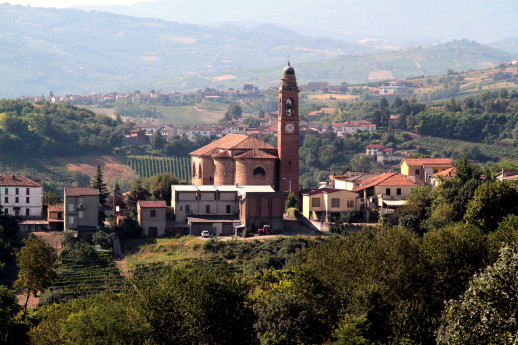
Canneto Pavese is located at one of the most panoramic points in the area and split up into tiny villages dotted over the peaks of the small round hills between the left bank of the Versa stream and the ridge of the slopes over the right bank of the Scuropasso stream.
Canneto Pavese

Ponte Nizza

Abbazia di Sant’Alberto da Butrio, near Ponte Nizza, was founded by hermit saint Alberto of Butrio in the 11th century on the summit of a limestone outcrop and soon became a Benedictine closed order. A painting inside shows the miracle performed by the saint in the presence of the Pope and three cardinals with which he proved that he had not committed the sin of breaking his fast as accused. In the surrounding area, the historic Pieve church of San Ponzo has a surviving attractive medieval plan with a beautiful church. It is for this reason that Ponte Nizza is a religious tourism destination.

Rivanazzano Terme

A few kilometres away from Voghera near the Staffora stream, you come across the town of Rivanazzano Terme. The site is known as a well equipped spa town. Its bromide and iodide salt and sulphurous waters are popular for their high concentrations of elements which are indispensable for the healthy functioning of the body. Rivananzzano Terme's waters are especially suitable for respiratory, musculoskeletal and superficial vascular system cure, prevention and rehabilitation. They have also been found to be effective in curing rhinogenic deafness and skin conditions. Studies have been carried out on the beneficial effects of the waters on children in whom inhalation cures can prevent the respiratory conditions typical of the winter months.
Rivanazzano