I found 523 results for Borghi

Tromello

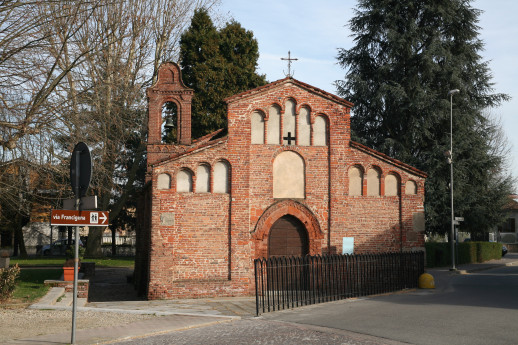
Along the right bank of the Terdoppio stream, on the road connecting Pavia to Mortara, is the first stop of the Via Francigena.
Parrocchiale di San Martino

Olevano di Lomellina

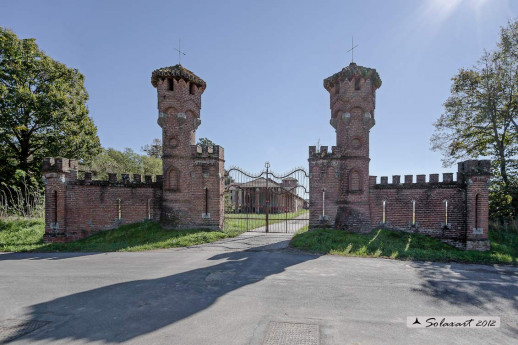
Olevano di Lomellina is a small municipality in the province of Pavia, located in the region known as Lomellina, between the Po, Sesia, and Ticino rivers. It is a town with ancient origins, whose existence has always been tied to agriculture, which still remains the main activity today. The vast plain of Lomellina, where Olevano stands, stretches between the Ticino, Po, and Sesia rivers: "a strange, unsettling, and fascinating land that offers visitors vast spaces, great silences, and wide horizons, so rare in Italy." Here, everything has been built, transformed, and organized by man with infinite and centuries-old patience; by nature, this land of springs would be an impassable swamp: and indeed, it was such for centuries. Then, the monastic communities in the Middle Ages, the feudal colonization in the 1200s, and the great agronomic reforms introduced by the Sforza family, who experimented with rice cultivation in the second half of the 15th century, turned Lomellina into a mosaic of rich cereal fields. To serve this vast cultivation, a complex system of canals and ditches was organized, and typical closed-court farmhouses, characteristic settlements of industrialized agriculture in the Po Valley, were built. Today, the laborious cycle of rice cultivation, based on transplanting and cleaning the grain by the rice women (mondine), in fields previously planted with forage, with continuous crop rotation, is just a memory; fertilizers, herbicides, and mechanical means have greatly simplified the work cycle, which begins in April with leveling, flooding, and sowing the rice directly in the rice paddies, and ends in September with the harvesting, threshing, and drying of the grain. Even though the "singing" rice women have disappeared and the number of croaking frogs has greatly decreased, the Lomellina region still retains a fascinating, discreet charm in its vast, deep, and mysterious spaces, scattered between sky and water. In 2018, the Museum of Art and Agricultural Traditions was inaugurated. It collects the most significant objects from the Lomellina agricultural world from the 1800s to the 1960s. It is housed in a renovated rural building, once used as a stable and hayloft, located on Via Uberto de' Olevano, in front of the Medieval Castle. On August 15 and 16, during the feast of Saint Roch, the Sagra del Salam dla Duja is held, featuring the typical pork salami preserved under fat in terracotta pots. "La duja" is a clay pot in which salamis, made with pork, salt, and pepper, are dried and aged for about a month before being placed in the pot and covered with lard. SOURCE: MUNICIPALITY OF OLEVANO DI LOMELLINA Photo:  Solaxart - Preboggion - Milano 
Montebello della Battaglia

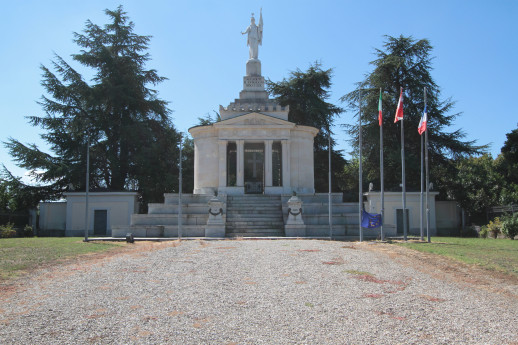
The territory of Montebello della Battaglia, divided between plains and green hills, has been the setting for many historically significant events. The fertile land at the mouth of the Valle Coppa is dotted with charming rural settlements and historic farmsteads that make its landscape truly unique. On May 20, 1859, the Piedmontese cavalry and French infantry clashed between Montebello and Genestrello with the Austrian 5th Army Corps, bravely repelling their repeated attacks. The battle was so important that it soon led to the creation of the regiment of the “Lancers of Montebello.” On May 20, 1882, a small Ossuary was inaugurated on the battlefield to hold the remains of the fallen soldiers from the three armies. The battle also inspired the famous story La piccola vedetta lombarda (“The Little Lookout of Lombardy”), included in Cuore, the celebrated novel by Edmondo De Amicis. The moving tale was inspired by the true story of a young boy from the countryside near Voghera, who climbed a tree to watch the advance of the Austrian troops. Exposed to enemy fire, he stood his ground bravely and died in the arms of an Italian officer — the first victim of the battle. The Beccaria Castle of Montebello della Battaglia, a noble residence of the Oltrepò Pavese area, was built toward the end of the 15th century in Montebello, a fief of the Beccaria family — a distinguished and renowned Italian lineage — by order of Galeazzo Maria Sforza Visconti, Duke of Milan. In the following centuries, the property passed to several noble families: the Bellocchio family, who lived there for about three centuries; the De Ghislanzoni family, for over a hundred years; and finally, the Premoli family.
Ossario dei Caduti di Montebello della Battaglia

Pietra de' Giorgi

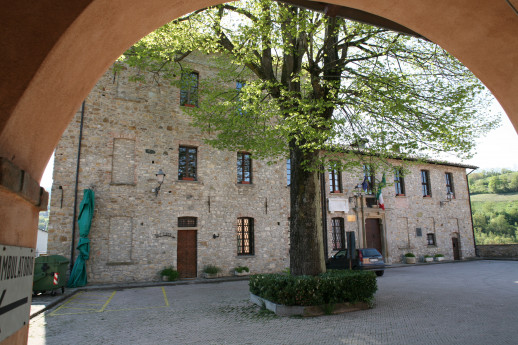
After the destruction of the ancient fortress of Predalino in the locality of Castellone, today Pietra de’ Giorgi still preserves an evocative castle dating back to the year 1000, featuring a surviving crenellated tower and a charming courtyard with a pointed arch doorway and a very deep well. The Castle of Pietra de’ Giorgi, which stands on the top of the hill in a strategic position, is considered one of the oldest in the Oltrepò Pavese, as it is believed to date back to 1012. In Pietra there once stood another castle, that of Predalino (today known as Castellone), which unfortunately was destroyed and of which no trace remains; in the mid-18th century, a ruined tower could still be seen. Within its walls, the Castle of Pietra includes the privately owned fortress and a residential palace purchased by the Municipality of Pietra de’ Giorgi in 1877, which now serves as the Town Hall. As already noted, the castle is believed to date back to 1012 and originally belonged to the noble Sannazzaro family. In 1277, the Ghibellines of Pavia decided to curb the power of the Guelphs, led by Guglielmo Sannazzaro, who had taken refuge with his soldiers in the Castle of Pietra. In April and May of that same year, the castle was besieged but never captured. In January 1290, the castle endured another siege by the Marquis of Monferrato, but this too proved unsuccessful. Over the centuries, the political landscape changed, and in 1402 the Castle of Pietra was destroyed by the Beccarla family (Ghibellines), long-time enemies of the Sannazzaro. The Sannazzaro were declared rebels by Filippo Maria Visconti, and on April 15, 1406, the Castle of Pietra was granted to Galvagno and Antonio Beccarla, counsellors to the young Filippo Maria. The deed of donation mentions the site where the ruined fortress once stood, along with the adjoining villa and surrounding lands. During the Beccarla ownership, the castle was restored to its former splendour, and the village took the name Pietra Beccaria. (Source: www.visitoltrepo.com)
Pietra de' Giorgi

Nicorvo

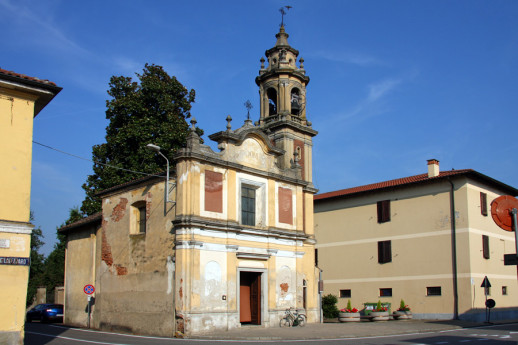
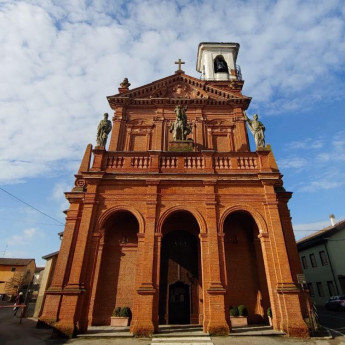
Located between Vercelli and Mortara, Nicorvo is a small village immersed in the tranquility of the rice fields. Since 2006, a small group of volunteers has been taking care of pilgrims walking the Via Francigena who request hospitality. The parish church is dedicated to San Terenziano, the patron saint of the village. Consecrated in 1620, it has five altars, and several fine paintings can be seen, with the best being the one in the choir, which depicts the Blessed Virgin of the Rosary with the Child Jesus and Saints Dominic and Terenziano, Bishop. The painting is attributed to the Lanino school, which is thought to have worked in the area during the time the church was built. Another church very dear to the people of Nicorvo is the one they call the "Madonnina," dedicated to the Madonna del Patrocinio. Built in 1764, it assumed its current form in 1910 after several restorations. In the Parish House in the center of the village, 8 beds with mattresses are available (additional cots or mattresses can be added if needed). In the large hallway adjacent to the Parish House, bicycles can be parked sheltered from rain and indoors. For more information, you can write to: HOSPITALITY MADONNA DEL PATROCINIO AND SAN TERENZIANO email: ospitale.francigena.nicorvo@gmail.com facebook: Nicorvo Via Francigena @nicorvo.viafrancigena instagram: nicorvo.viafrancigena telegram: Ospitale Nicorvo tel. +39 371 5174578   Photo Di Alessandro Vecchi - Opera propria, CC BY-SA 3.0, https://commons.wikimedia.org/w/index.php?curid=10745415
Di Alessandro Vecchi

Mede

Situated midway (perhaps the origin of its name Mede) between the Sesia and Agogna rivers, sections of 14th-15th century Sangiuliani Castle's walls are still visible in the town centre together with an elegant loggia built at a later date and a battlemented tower. The Ugo Fantelli archaeology and naturalistic collection is kept at the castle as well as the Regina Cassolo Bracchi museum with its sketches, tempera paintings, collages and sculptures by this great Futurist sculptor.
Castello di Tortorolo

Robbio

Located along the Via Francigena, Robbio was in the Middle Ages a Vercelli outpost within the territory of Pavia. Its many Romanesque churches evoke the former splendor of this Lomellina village. In Robbio stands the Monastery of San Valeriano, a Romanesque-style church founded in the early 12th century by the powerful Lomellina family of the Besate, who made it dependent on the Burgundian Abbey of Cluny. The monastery was one of the hospitality centers for pilgrims traveling along the Via Francigena. The Church of San Pietro, Romanesque and dating from the last quarter of the 12th century, features a façade built by the Comacine Masters. Inside, 16th-century frescoes attributed to Tommaso da Mortara can be admired. Next to the church once stood a shelter for pilgrims. The Church of San Michele shows both Romanesque and Gothic elements. Its façade is decorated in the style typical of 15th-century Lombard art. Inside, there are 16th-century frescoes from the Vercelli school, among which stands out the Madonna enthroned, attributed to Bernardo Lanino. The Castle of Robbio, located in the center of the town, was built in the 14th century. It has a quadrangular layout with an open courtyard and a beautiful tower known as the Torre Sanner. The Oratory of San Rocco is a small rural church, probably erected during the terrible plague of 1578 in an isolated and marshy area, which remained so until the 19th century and was used as a lazaretto. Inside, there are frescoes and a beautiful Madonna and Child with Saints Roch and Sebastian, dating back to the same period as the construction of the chapel.
Robbio Chiesa di San Pietro

Gropello Cairoli

Only the north and east wings of the original square plan Visconti period castle have survived. To the right of the façade, a massive tower with an airy ogival window framed by terracotta rosettes and with a sill supported by small intersecting arches, has also survived. The rear façade of the castle features a large hanging fireplace, an external walkway and pointed arch windows. Gropello owes its supplementary name - Cairoli - since 1888 to the five patriotic sons of Carlo Cairoli, Benedetto, Enrico, Ernesto, Luigi and Giovanni who lived here with their mother Adelaide and played a front rank role in the Italian Risorgimento.

Romagnese

Romagnese preserves the features of a medieval village, although its origins are much older, as evidenced by archaeological finds of Roman origin. Much of its historical prominence is linked to the rise of the Dal Verme family. The Dal Verme lineage governed these lands and built the 14th-century castle. Today, as a testament to its former splendor, two structures remain from the original complex: the tower and a sandstone building with a beautiful 19th-century portal. In the municipality of Romagnese, at an altitude of 950 meters on the slopes of Monte Pietra di Corvo — a striking outcrop of dark volcanic rock — lies the Pietra Corva Botanical Garden. The garden was established to conserve and adapt mountain plants native not only to the Alps but also to other mountain ranges such as the Himalayas and the Andes. Thanks to the area’s unique microclimate, these species have adapted perfectly. A small part of the Monte Alpe Nature Reserve (part of the Natura 2000 Network) also lies within the municipality of Romagnese, bordering the towns of Menconico and Varzi, and is managed by ERSAF – Regione Lombardia. In the castle tower of Romagnese is located the Museum of the Lombard Apennines of the Four Provinces. The museum was created to preserve and showcase local traditions: it houses tools, implements, and machinery once used in the agricultural and artisanal life of the region. The parish church, dedicated to Saint Lawrence, contains a painting attributed to Palma il Giovane and a distinctive wooden altar known as the “Rosary Altar.” Among the many oratories surrounding the village, one worth visiting is the Oratory of Penicina, dedicated to the Madonna of Caravaggio. Its Pisan-style façade is built with alternating bands of brick and sandstone, while the pilasters date back to the 16th century.
Romagnese

Retorbido

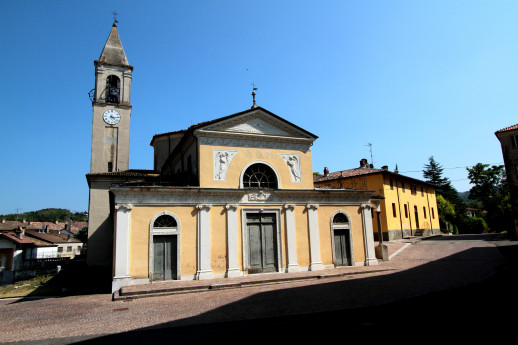
Known in Roman times by the name Litibium, the town of Retorbido was given by Lombard king Liutprand to Pavia monastery San Pietro in Ciel d'Oro. Long at the centre of bitter territorial disputes, in 1753 it passed to the Savoys. It is to this period that its neo-classical buildings such as Chiesa Parocchiale della Natività della Beata Vergine Maria and Palazzo Negrotto Cambiaso Durazzo Pallavicini (18th century) date.
Chiesa Parrocchiale della Natività della Beata Vergine Maria

Breme

A small medieval village rich in history at the confluence of the Po and Sesia rivers in Lomellina

Lomello

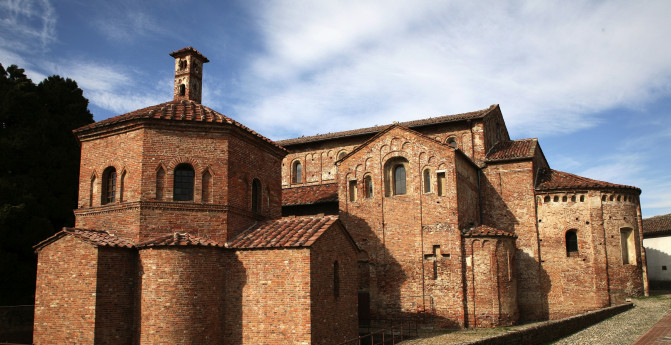
In the 6th and 7th centuries Lomello was the occasional residence of the first Lombard kings and its royal status was confirmed in the imperial period when the Lomello counts began to extend their rule to the surrounding areas. The Collegiata di Santa Maria Maggiore complex and the Battistero di San Giovanni ad Fontes, built in the heart of the Lombard kingdom with its ancient baptismal font in hexagonal shape and painting decorations dating to the 7th century, are both of great historic, artistic and architectural interest.
Lomello