• Art & Culture
    • Lifestyle

Palazzo d'Arco in Mantua

Everyday life of a noble family in the 18th and 19th Century

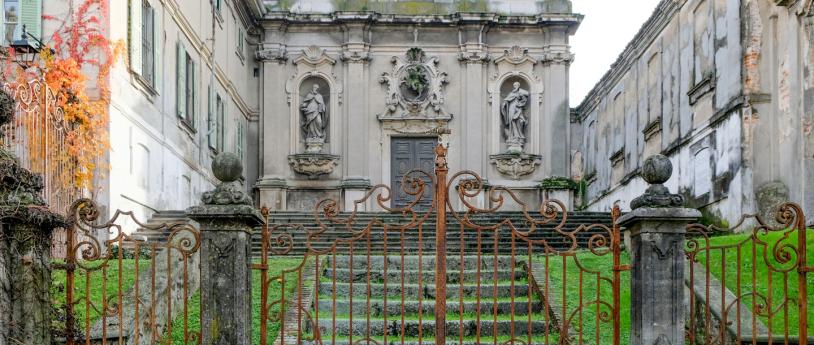
The imposing facade of the neoclassical 18th century residence of the Counts D’Arco is overlooking a large cobbled square.

Beyond the entrance hall, past the semicircular exedra, you glimpse the coloured and scented garden with flowers and plants, fruit trees and aromatic herbs. Climbing the monumental marble staircase, you arrive to the noble floor, where the furnished rooms reveal the lifestyle, the elegance, the flair and the passions of the noble family D’Arco, extinguished only half a century ago, that could boast an history of nine hundreds years.

From the great Ancestors’ Hall, you go on into the private apartments of the landlord and the landlady, where the chandeliers and the Murano glass lamps give light to the reception rooms for the guests to whom tea, coffee or chocolate were offered in precious Meissen porcelain cups and silver services.

You will also visit private little studies, a dressing room, an English Victorian style smoking room for gentlemen only, where they smoke cigars and speak about politics. Your eyes will be attracted by inlaid furniture, chests of drawers, tables set with ancient porcelain or ceramic services.

The heritage is so rich and varied thanks to the last countess Giovanna, who died in 1973, and generously gave such wealth to her beloved Mantova and to the visitors of the  only museum-house of the city. Cultivated and intelectuals, the Counts D’Arco collected a valuable art gallery with paintings by Lorenzo Lotto, Bernardino Luini, Sodoma, Grechetto, Antoon van Dyck. The remarkable library has manuscripts and incunabula, cinquecentine and ancient books available to anyone who wants to consult them.

You cannot miss the kitchen, whose walls are covered with copper moulds of different and unusual shapes used to cook puddings, jellies and pies; copper jugs, bowls, lemon squeezers, coffee pots, big pans are exhibited together with all was needed to please the palate of the refined lords.

The surprises are not finished: in the garden two ancient little buildings give hospitality to a naturalistic collection and to an amazing room frescoed by the painter Giovanni Maria Falconetto in 1520. Under big painted arches the twelve signes of the zodiac are told through myths, heroes of the past, ancient monuments to appreciate the step back in time at its best.

-

Ph cover: Federica Bottoli

Text and images in gallery by MARTA PETRUZZELLA, ConfGuide Mantova 

CLICK HERE to discover her other itinerary proposals.

Take me here: Palazzo d'Arco in Mantua

On the same topic

Mantua Culture Capital 2016

Mantua city of art, capital of culture
  • Art & Culture
Mantua Culture Capital 2016, discover its wonders

Online i modelli di Stradivari dell’MdV

On Google Arts & Culture!
  • Art & Culture
Online i modelli di Stradivari dell’MdV

Monuments Bergamo

Bergamo and its province offer monuments of rare beauty. Discover the main monuments to visit
  • Art & Culture
Monuments Bergamo, choose what to see in Lombardy

Cremona and its music

Cremona's music is closer than what you think
  • Art & Culture
Cremona and its music

Castles and fortifications around Lake Como

Several testimonies of a past rich in history, all to discover
  • Art & Culture
@primalavaltellina.it

The Cloister of Voltorre

The monastic art of the Cloister of Voltorre
  • Art & Culture
The monastic art of The Cloister of Voltorre

House Museums of Lombardy: step inside the homes of renowned historical figures

Discover the history and culture of the Region of Lombardy through its historic house museums, from the homes of famous people and art collectors to artists' studios.
  • Art & Culture
Case Museo in Lombardia - Villa Manzoni, Lecco

Museums Mantua

Indelible traces of a past full of history and emblematic characters. Museums tell us about the rich biography of the territory
  • Art & Culture
Museums Mantua, cultural hubs in Lombardy

The paths of Spriana

To visit Spriana is to step into the past, discovering a small farming village
  • Art & Culture
Scilironi

Itinerary Mincio Po Rivers

A pleasant itinerary to discover the naturalistic and architectural riches of this strip of Lombardy.
  • Art & Culture
Itinerary of Mincio and Po rivers, exploring on two wheels

What does a Brazilian do at La Scala?

The affairs of Brazil's greatest composer and his connection with La Scala Theater in Milan
  • Art & Culture
What does a Brazilian do at La Scala in Milan?

What to see in North Milan

The North Milan Area, between North Park and some must-see gems
  • Art & Culture
North Milan Area

Legend of the Seven Brothers

An evocative tale of eight brothers, linked to each other, who lived in the Lecco area
  • Art & Culture
Traditions of Lecco: Legend of the Seven Brothers

San Pietro a Gemonio

This church is one of the points that remain more etched in the memory of the travelers who travel the Varese-Laveno
  • Art & Culture
San Pietro a Gemonio and the Salvini Museum in Cocquio Trevisago

Theatre: what’s on stage in Lombardy 

In Lombardy, theatres are opening up safely: here are some of the must-see shows and festivals
  • Art & Culture
Teatro: chi è di scena in Lombardia

Theaters Bergamo

The theatrical season of Bergamo accompanies us with a flourishing billboard of shows not to be missed
  • Art & Culture
Theaters Bergamo, hints on visiting

Festival of Ethical Photography

Responsible photojournalism: The Festival of Ethical Photography
  • Art & Culture
Festival della Fotografia Etica

Bergamo Photo Gallery

An area to be discovered and visited
  • Art & Culture
Discovering Bergamo from A to Z

Bergamo Bassa

In Bergamo the visit starts from the bottom of the town, from its historic villages, and goes on by climbing slowly
  • Art & Culture
Historical places and green areas in Bergamo

Bergamo, Crespi d'Adda

  • Art & Culture
Villaggio Crespi d'Adda