- Art & Culture
Between ancient memories and majestic landscapes
This area, which can be reached more quickly from Milan thanks to the freeway system and which flows into the Trivio de Fuentes, offers the possibility of a nice day trip. Moving by car, while by public transportation (train and local buses) is very complex, it is possible to reach several stops on the itinerary.
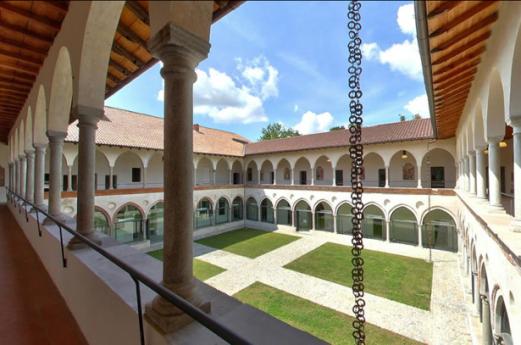
A place rich in memories and evocative is the abbey of San Pietro in Vallate in Piagno, which can be reached on foot from the cluster of houses in the hamlet of the same name in Cosio Valtellino. Set in a dominant position on the valley floor route, the ancient Romanesque abbey is one of the oldest and most important buildings in Valtellina. The bell tower and part of the church's perimeter walls remain of the complex.
The complex, consisting of church and convent, was built in 1078, when Otto and Bonizza of the Comacina Island donated the land to the monks of Cluny (reformed branch, of the Benedictine order). Later, in 1024 , the monastery was attached to the priory of Piona, on Lake Como, which is still a Benedictine seat today. We do not know the reasons for the decline of the Vallate monastery and then its abandonment, which, it seems, was already complete shortly after the mid-16th century.
The church initially had two naves crowned by apses. The lesser one had incorporated the bell tower, short and sturdy. It still stands as the sign that, in the area, rekindles the memory of the whole complex. Very interesting are the external decorations of the apse, characterized by the presence of small half-columns, splayed windows, small arches and frets. The skillful use of the most common local stone allowed to achieve the maximum expressiveness. The restoration of the monument was due to Eng. Antonio Gussa of Como between 1914 and 1916.
Not far from the hamlet, on the road leading to SS.38, it is also possible to visit a small church, simple, white and with very pleasant forms. It is dedicated to Saints Gervasius and Protasius.
Leaving the Orobic side, across the bridge of Ganda, one passes on the Rhaetian foothill road (now S. 104 in ancient times called the Valeriana), which is certainly a very ancient route and which sees its importance grow as the order of domination over the Valtellina changes. The road only marginally touches the houses of Traona, which stands tall on the conoid of the Vallone stream. Of the settlement one can recognize the main church raised on mighty arches. A thriving village, it developed in the Middle Ages due to the presence of the Vicedomini of Como, who held the castle of Domofole in Val di Mello.
It is worth climbing up to the archpriest's church of S. Alessandro to enjoy a wonderful panorama, which extends to the entire Lower Valley and allows one to understand the history of the places. The interior of the church, spacious and majestic in its single nave, has many frescoes painted by Giacomo Parravicini known as Gianolo, of particular scenic effect are the figures adorning the triumphal arch and the "Glory of St. Alexander."
Also in the historical center of Traona, a village of great importance in medieval times, it is possible to see some particular buildings (Parravicini palace, Torri house, Masseroni house, former town hall, Bellotti house, Vertemate palace) among which I recommend the church of St. Ignatius, positioned in front of the Parravicini palace, inserted in the street curtain with its facade surmounted by a bell tower, a church that Ignazio Parravicini wanted to have erected in 1780 in front of his palace. Of this mansion, entering the gateway, one can admire the porticoed courtyard with arches and columns on two floors. The interior of the church is striking, a small Greek-cross hall inscribed in a square and covered by a dome surmounted by lanterns from which intense light filters in, dilating the space. Even from the small sacristy, light filters into the oratory from the openings of the ambulatory, with a refined and soft scenic effect.
The complexity of these buildings, built when Neoclassicism was already taking hold, is extraordinary in relation to the architectural culture of the Valley: themes, motifs and solutions from the Roman Baroque are assumed. The architect in charge of the cultured project was Petro Solari of Bolvedro in the period 1780-1781; he was particularly active in Valtellina and Valchiavenna, but he was also up to date with the artistic experiences of European capitals.


Leaving the village of Traona, it is possible to penetrate among the valleys of the tributaries of the Adda and proceed toward Mello, where, on the overhang of the torrent, the Castle of Domofole rises; on the sunny coast "of the Cechs," in fact, it was built at an undefined time, probably around 1100. Used as a garrison by the feudal lords of the Bishop of Como, it has undergone destruction and rebuilding over the years. Today only the central tower, part of the surrounding wall and part of the churches built in its vicinity are visible. The tower, with a quadrangular plan, is built with thick walls of squared stones with cavity filled with mortar and stones, given the presence of numerous windows and loopholes, it is inferred that the interior was habitable.
Interestingly, like many fortifications, including those in the Larian area, the early medieval castle was popularly called the Queen's Castle due to widespread belief that the Longobard queen Theodolinda had dwelt there. Instead, it is likely that the fortress was rather the prison of a lesser-known Lombard queen falsely accused of plotting to have her husband, King Arioaldo (or Rodoaldo), killed with the complicity of the Duke of Tuscany, Tosone. Countless are the tales and legends that over the centuries have fabled about Domofole Castle; ghosts, witches and heroes, who populated collective imagination in the valley, have taken image and substance around these ancient walls.
Text edited by SARA NUZZI, ConfGuide-GITEC licensed guide.
If you enjoyed this story, CLICK HERE to discover its various itinerary suggestions.